You know the details that do not always show up during an appointment: the song your child asks for on repeat, the part of the morning that feels rushed, and the way they let you know they need a break.
Those everyday observations are worth sharing with your child’s ABA team. If you are wondering what to bring up at your next meeting, you do not need a perfect report or a list of clinical terms. Start with what matters to your child and your family.
This guide offers conversation starters for families beginning applied behavior analysis (ABA) therapy or checking in on an existing plan.
Start with your child’s strengths and interests
Before getting into challenges, introduce the person behind the paperwork. What makes your child laugh? What do they choose when they have free time? What are they proud of learning?
You might mention a love of trains, a favorite playground, a strong memory for songs, or the patience they show while building something. Share activities they prefer to enjoy on their own, too. An interest does not have to become a lesson to be valuable.
Try opening with: “Here are a few things I want you to know about who my child is.”
Describe what communication looks like at home
Tell the team how your child expresses choices, asks for help, says no, or shows excitement. Include words, gestures, pictures, signs, or a communication device they already use. Mention examples that may be easy for familiar people to understand but less obvious to someone new.
For example: “When she brings me her shoes, she is usually asking to go outside,” or “He turns away when he wants a pause.”
Ask how the team will recognize your child’s preferences and respond when they communicate discomfort or want to stop. Your child’s perspective belongs in the conversation, including when they communicate without speech.
Choose a few everyday priorities
A long list of concerns can make it hard to know where to begin. Consider bringing two or three situations you would most like to discuss. These are starting points for a conversation, not a treatment plan you need to create yourself.
- Asking for support: “I would like us to understand when he needs help before he becomes frustrated.”
- Daily routines: “Getting ready to leave the house is the hardest part of our morning.”
- Enjoying activities: “She loves the park, and I would like to talk about what could make visits more comfortable.”
Explain why each priority matters. Is it connected to your child’s independence, comfort, safety, or ability to take part in something they enjoy?
The Behavior Analyst Certification Board’s Ethics Code calls for involving clients and relevant stakeholders in goal selection and ongoing progress monitoring. Ask your supervising Board Certified Behavior Analyst (BCBA) how your priorities connect with the proposed goals and assessment findings.
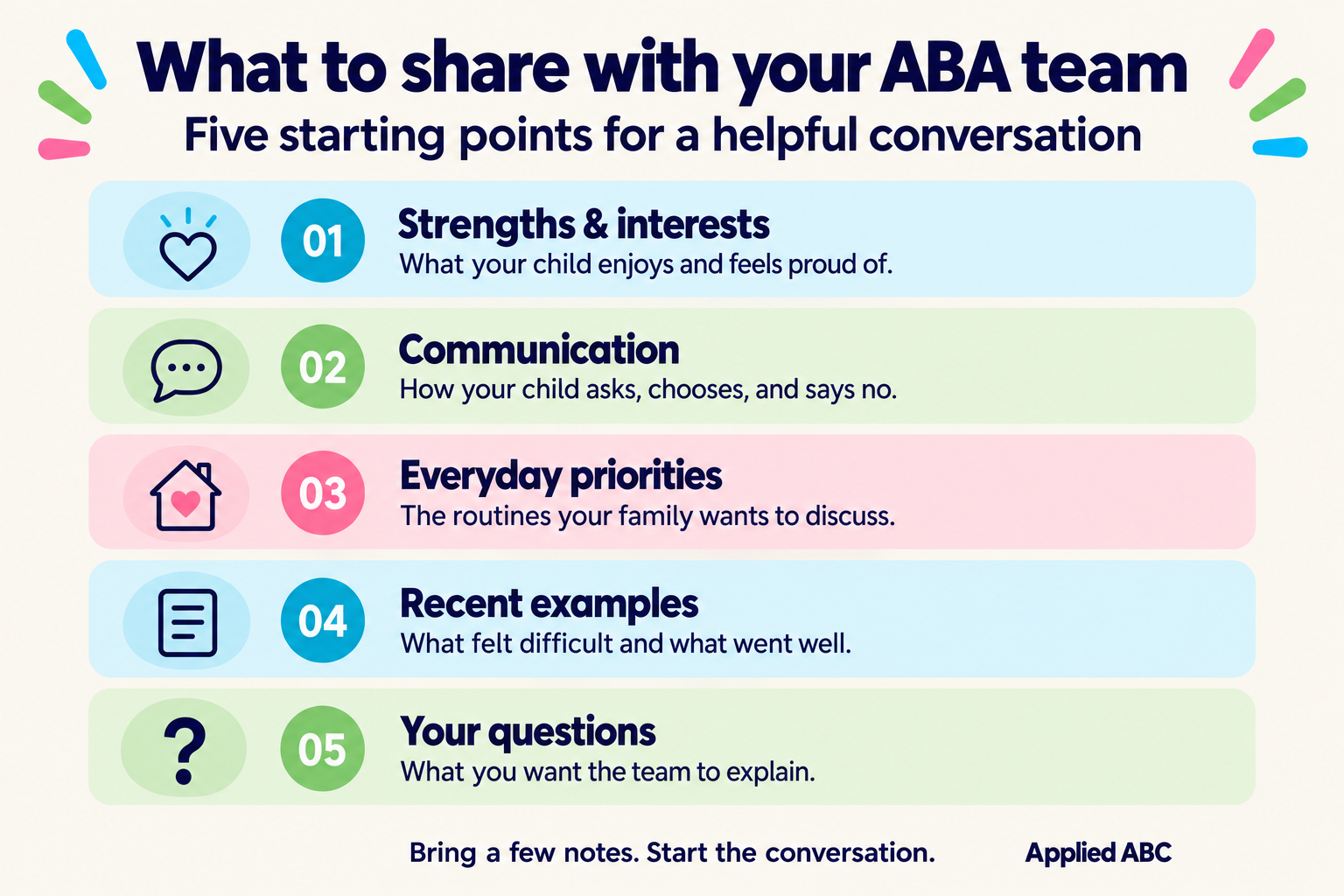
Bring specific examples, including what went well
“Afternoons are difficult” gives your team a starting point. A short description gives you more to discuss: “Yesterday, he came home, covered his ears while the television was on, and went to his room. Later, he joined us when the living room was quieter.”
You do not have to decide what an observation means. Simply describe what you noticed and let the team ask follow-up questions. Include smoother moments as well: an easier transition, a new request, or a favorite activity your child enjoyed.
A few notes on your phone can be enough to organize your thoughts. Ask your team what information would be useful before taking on detailed tracking at home.
Be honest about your family’s routine
Work schedules, siblings, transportation, home languages, and caregiver availability are part of your family’s daily life. Bring them into the discussion.
If a suggestion feels unrealistic, say so. You can ask: “What could this look like during the time we actually have?” or “Could you show us one example we can talk through together?”
For families considering home-based ABA therapy, it can also help to describe the spaces and routines your child already knows. Ask which parts of the plan involve caregivers and what support is available for learning those steps.
Ask what progress will look like outside a session
When reviewing a goal, ask for an everyday example. What would you notice at home or in another familiar setting? What information will the team use to review progress? When will you discuss whether the goal still fits?
You can also ask:
- “Can you explain this goal in plain language?”
- “How will my child’s choices be included?”
- “What should I do if something feels uncomfortable or is not working for our family?”
- “Who should I contact with questions between meetings?”
For more background, explore our guide to ABA treatment plans.
A simple note to bring to your next meeting
Use these five prompts to prepare. A sentence or two for each is enough:
- My child enjoys…
- My child communicates choices and discomfort by…
- One part of our day I would like to discuss is…
- Something that went well recently was…
- My biggest question for the team is…
You do not need to have every answer before the conversation begins. Bring your observations, ask your questions, and make room for your child’s preferences along the way.
Connect with Applied ABC
Looking for support or exploring ABA services for your family? Contact Applied ABC to discuss your questions and available services. You can also explore our parent training resources.