
One Month In: Addressing Student Behaviors in Schools
One month into the school year, classroom routines are beginning to settle, expectations are becoming clearer, and patterns in student behavior may be easier to identify.
As academic and social demands increase, some students may demonstrate frustration, avoidance, refusal, difficulty transitioning, or other challenging behaviors. When these behaviors continue, school teams are often left asking an important question: Why is this happening, and how can we help?
Understanding the reason behind a behavior is an important first step toward creating effective, individualized support.
Understanding the “Why” Behind Student Behavior
School teams may see students leave the classroom, refuse assignments, struggle during transitions, or engage in disruptive behavior. Rather than focusing only on stopping the behavior, it is important to understand what may be contributing to it.
Looking closely at what happens before and after a behavior can help identify meaningful patterns.
For example:
- Does the behavior occur during certain subjects or activities?
- Does it happen when a difficult assignment is presented?
- Is it more common during transitions?
- What typically happens immediately after the behavior?
These observations provide valuable information that can help school teams better understand what a student may be communicating through their behavior.
How a Functional Behavior Assessment (FBA) Helps Schools
A Functional Behavior Assessment (FBA) is a structured process used to understand why a challenging behavior is occurring.
A comprehensive FBA may include observations, interviews, record reviews, behavioral data, and other relevant information. By examining this information together, a Board Certified Behavior Analyst (BCBA) can identify potential triggers, patterns, environmental variables, and consequences that may be influencing the student’s behavior.
Instead of addressing only what the behavior looks like, an FBA helps teams investigate the function of the behavior.
This information allows schools to develop behavioral interventions that address the student’s individual needs and teach more appropriate skills, rather than relying on short-term responses that may not resolve the underlying issue.
The Importance of ABC Data Collection in Schools
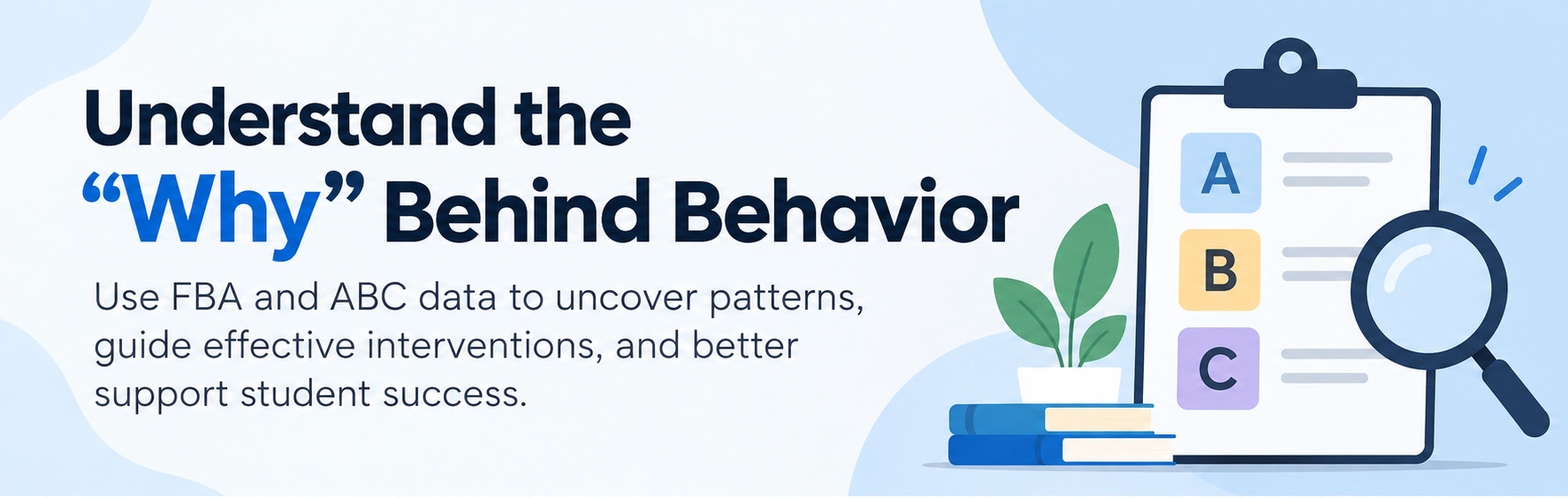
ABC data collection is one method schools can use to better understand student behavior.
ABC stands for:
Antecedent: What happened immediately before the behavior?
Behavior: What did the student do?
Consequence: What happened immediately after the behavior?
Consistently documenting these three components gives school teams a structured way to organize behavioral observations and identify patterns over time.
For example, a team may discover that a student’s challenging behavior frequently occurs after difficult academic tasks are introduced and is followed by removal from the assignment. Identifying patterns like this can help behavioral professionals determine what additional assessment or intervention may be needed.
ABC data can be especially valuable for districts with limited behavioral resources. By training teachers, paraprofessionals, administrators, and other school staff to collect behavioral data accurately, BCBAs can access important information even when they cannot personally observe every situation.
Applied ABC’s School-Based Behavioral Services
Applied ABC offers comprehensive School-Based Services designed to help districts better understand and address challenging student behavior.
Our team includes experienced Analistas de comportamiento certificados por la junta (BCBA) who can conduct Functional Behavior Assessments and provide practical, data-informed recommendations based on each student’s needs.
Applied ABC also helps school teams simplify behavioral data collection. Staff can document behavioral observations using easy-to-use digital forms that organize information in real time.
With tools designed to support pattern identification and customizable reporting, schools can transform everyday observations into meaningful information that supports better behavioral decision-making.
The goal is to make data collection useful and manageable—without unnecessarily increasing the workload of already busy school teams.
Building District Capacity for Behavioral Support
Effective behavioral support requires more than technology.
Applied ABC’s BCBAs work collaboratively with teachers, administrators, related service providers, paraprofessionals, and other school personnel to help districts strengthen their internal behavioral support systems.
Our School-Based Services can include:
- Functional Behavior Assessments
- Behavioral observations and data collection
- ABC data tracking
- Behavior intervention recommendations
- Staff training
- Implementation coaching
- BCBA consultation and support
Through hands-on training and ongoing coaching, school staff can build the skills and confidence needed to implement behavioral strategies consistently.
Building this internal capacity can help districts respond to behavioral challenges more proactively, strengthen positive school environments, and provide students with appropriate support when they need it.
Turning Behavioral Data Into Better Student Outcomes
Understanding challenging student behavior begins with asking why.
When school teams combine thoughtful observation, Functional Behavior Assessments, ABC data collection, and evidence-based behavioral strategies, they can move beyond reacting to individual incidents and begin addressing the factors contributing to those behaviors.
Even districts that do not have behavioral specialists in every building can create systems that give teachers and school teams access to the information and professional support they need.
Applied ABC is designed to fit into existing school workflows, helping make behavioral data collection simpler rather than adding another complicated task to your team’s responsibilities.
Our goal is to help school districts turn everyday behavioral observations into meaningful insights that lead to effective interventions, stronger school teams, and better student outcomes.