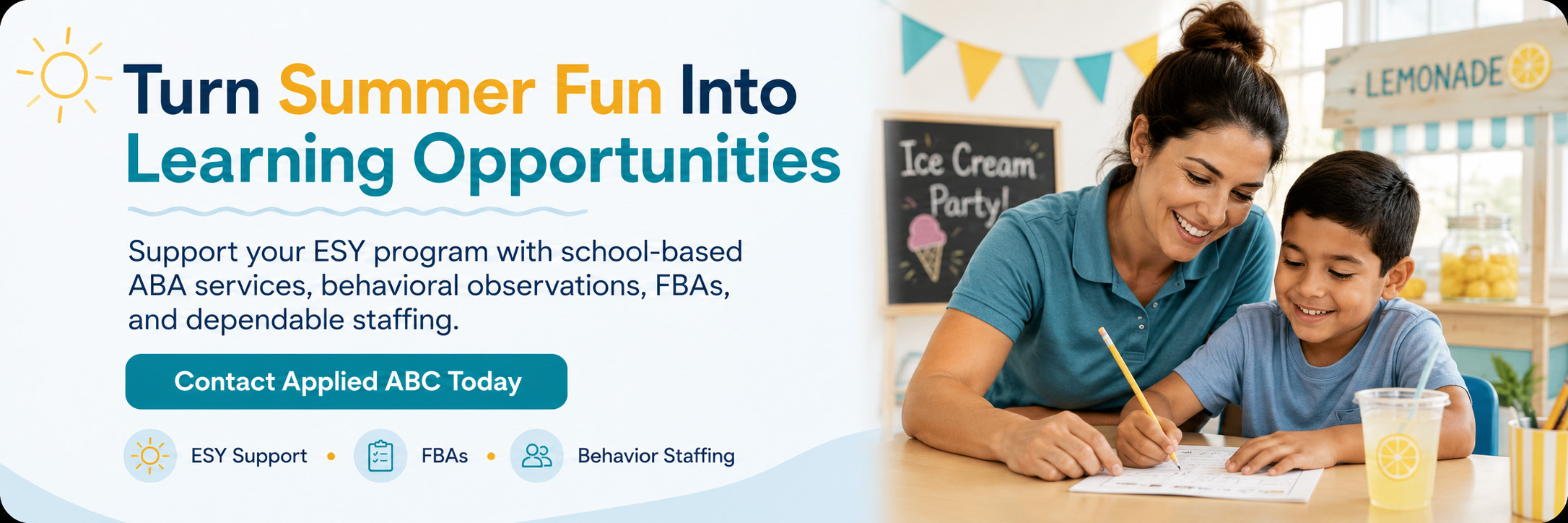

Summer is finally here! For most kids, that means pool days, melting ice cream, and neighborhood lemonade stands. However, for students on the autism spectrum, shifting from a highly structured school year to the relaxed days of summer can feel overwhelming.
District special education leaders and teachers strive to make learning fun during Extended School Year (ESY) programs. Yet, with ongoing special education staffing shortages, consistently meeting every student’s complex needs can be challenging.
This is where Applied ABC steps in.
Summer is the perfect time to partner with Applied ABC’s School-Based Services. We support districts nationwide with comprehensive behavioral observations, Functional Behavioral Assessments (FBAs), and reliable behavior staffing solutions. Our dedicated team of special educators and behavioral staff is ready to work alongside your district to create a fun, structured, and deeply supportive environment for every student.
Turning Summer Activities into Collaborative Learning
Extended School Year (ESY) programs offer a unique opportunity to blend summer fun with meaningful skill development. By utilizing Natural Environment Training (NET)—an ABA strategy where learning occurs within a child’s typical environment using naturally motivating activities—we can turn classic summer experiences into powerful teaching moments.
Here are two examples of how Applied ABC integrates ABA goals into everyday summer fun:
1. The Lemonade Stand: Building Social and Functional Skills
Setting up a school-wide lemonade stand is a memorable summer activity that naturally supports executive functioning, planning, organization, and social development. Many individualized education program (IEP) goals can be seamlessly integrated into this hands-on project:
-
Fine Motor Skills: Squeezing fresh lemons, measuring ingredients, stirring, and carefully pouring drinks.
-
Math and Cognitive Skills: Counting cups, handling money, calculating change, and predicting totals.
-
Social Communication: Practicing polite greetings, maintaining comfortable eye contact, and saying “thank you” to customers.
-
Speech and Confidence Building: For students navigating social anxiety or speech articulation goals, the structured and repetitive nature of a lemonade stand provides a safe, predictable environment to practice communication with teachers, peers, and visitors.
2. Ice Cream Parties: Mastering Patience and Coping Skills
Choosing an ice cream flavor, selecting a cone or cup, waiting patiently in line, and managing sensory experiences in the summer heat all present valuable, real-world learning opportunities.
Applied ABC therapists excel at breaking these moments down into manageable, teachable steps using evidence-based strategies like Task Analysis y Delay Tolerance.
-
Practicing Patience: Therapists utilize visual schedules, timers, and positive reinforcement strategies to help students learn how to wait successfully in lines.
-
Navigating Unexpected Changes: If a favorite flavor runs out or a preferred cone is unavailable, ABA therapists help students practice flexibility and coping skills through guided problem-solving.
-
Self-Regulation: Students learn to manage excitement, disappointment, and frustration by using targeted strategies such as deep breathing exercises, visual supports, or preferred calming tools.
Applied ABC Can Be Your District’s Summer Success Partner
Meeting Extended School Year (ESY) service requirements and overcoming staffing shortages doesn’t have to be a source of stress. Applied ABC’s School-Based Services provide the individualized, professional support school districts need to maintain and build upon the progress students achieved during the traditional school year.
This summer, every scoop of ice cream and every cup of lemonade can become a stepping stone for growth. With the right staff, structure, and clinical support, your ESY program can deliver meaningful learning experiences while creating joyful memories that last well beyond summer break.