

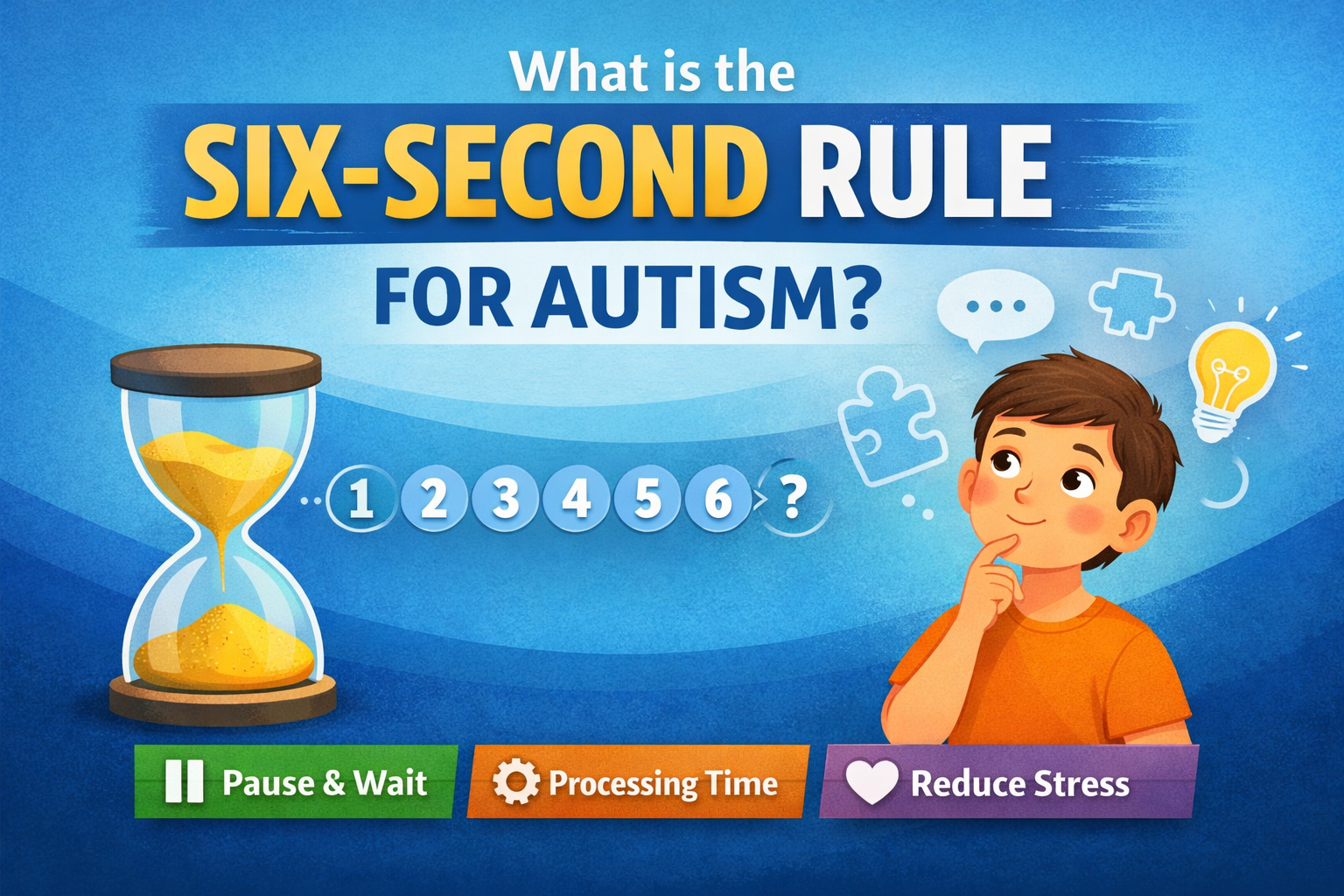
If you have ever asked an autistic child a question and gotten silence back, it is easy to assume they did not hear you, did not understand you, or are ignoring you. Often, the missing piece is simply processing time. The six-second rule is a practical communication strategy that encourages adults to pause for about six seconds after giving an instruction or asking a question before repeating themselves or adding more language.
That tiny pause can reduce stress, improve understanding, and make everyday communication smoother for many autistic children.
Quick definition: the six-second rule
The six-second rule means:
-
Say the instruction or question clearly.
-
Wait about six seconds (silently).
-
If needed, repeat using the same words.
The National Autistic Society describes this approach as giving information, waiting roughly six seconds to allow processing time, and then repeating the information using the same words if necessary.
Why “same words” matters
When we rephrase too quickly, we unintentionally add a brand-new language task. Instead of processing one instruction, the child now has to process two different versions, decide which one matters, and manage the pressure of a fast interaction.
Why a six-second pause can help autistic children
Autism is a neurodevelopmental condition that can affect communication, learning, and behavior. Many autistic children have differences in how they process spoken language, social cues, and sensory input. The National Institute on Deafness and Other Communication Disorders notes that children with ASD can have difficulty developing language skills and understanding what others say to them.
A pause helps because it:
-
Supports language processing: The child has time to decode what was said.
-
Reduces social pressure: Immediate responses can feel demanding.
-
Prevents “verbal overload”: More words can make it harder to sort the message.
-
Builds independence: Waiting creates a chance for the child to respond without prompts.
Is it always exactly six seconds?
Think of “six seconds” as a starting point, not a strict rule. Some autistic children may need more time depending on the situation, environment, and regulation level.
In fact, the National Autistic Society also advises that pauses give processing time and suggests that, as a general rule, giving at least 10 seconds can be helpful for autistic pupils, with more or less time depending on the individual and context.
A useful way to apply this is:
-
Start with six seconds for simple, familiar directions.
-
Use 10 seconds or more for multi step directions, new settings, or when the child is dysregulated.
How to use the six-second rule step by step
1) Get the moment ready
Before you speak, try to reduce competing noise or distractions when possible. If the TV is loud or a sibling is talking, your words may land on a busy sensory scene.
2) Use short, concrete language
Say the instruction once, clearly.
Examples:
-
“Shoes on.”
-
“Come to the table.”
-
“Show me red.”
-
“Do you want water or juice?”
3) Pause and count silently
In your head, count: 1…2…3…4…5…6.
This can feel uncomfortably long at first. Many adults rush to fill silence. With autistic children, the silence is often where the work is happening.
4) Repeat with the same words only if needed
If there is no response after the pause, repeat the exact same instruction once.
5) Add supports if the child still needs help
If repeating does not help, consider a visual cue, gesture, or a model. The key is not piling on extra language.
Real life examples you can try today
At home: morning routine
Instead of:
“Put on your socks. No, not those socks. Hurry up. We are late. Put them on now.”
Try:
“Put on socks.” (pause six seconds)
If needed: “Put on socks.” (same words)
Then point to the sock drawer or hold up the socks without adding more talk.
At school: transitioning to a new activity
“Clean up.” (pause)
If needed: “Clean up.”
Then gesture toward the bin or show a simple visual schedule.
During play: sharing and turn taking
“My turn.” (pause)
If needed: “My turn.”
Then hold out your hand as a nonverbal cue.
When asking a question
“What do you want?” (pause)
If needed: “What do you want?”
If the child struggles with open ended questions, switch the format after the second attempt by offering choices:
“Do you want crackers or apples?”
Common mistakes that can weaken the six-second rule
Mistake 1: repeating too fast
Repeating immediately teaches the child that waiting is unnecessary and removes their chance to process.
Mistake 2: rephrasing the question
“Put on your coat” becomes “Get your jacket” becomes “We need to leave” which becomes confusing.
Mistake 3: adding extra explanations
Extra language can feel like pressure, not help.
Mistake 4: turning the pause into a stare down
A neutral, calm presence usually works better than intense eye contact or a demanding tone. Your goal is to create space, not tension.
When the six-second rule is especially useful
-
Following directions (one step at a time)
-
Answering questions (especially in groups or busy settings)
-
De-escalation moments where the child is overwhelmed
-
Skill building in ABA sessions where independence matters
-
Social communication practice when you want the child to initiate
How Applied ABC can help families apply strategies like this
At Applied ABC, our clinicians and therapy teams work with families to build practical routines and communication strategies that fit real life, not just the therapy room. If you are exploring options, you can learn more about ABA therapy and how it works at Applied ABC here.
Depending on your child’s needs and your goals, Applied ABC offers multiple service formats, including home based ABA services and support through our network of ABA therapy centers. If you are new to the process, our guide for families starting ABA can also help you understand what to expect.
If you want to talk with our team about services, you can reach us through our contact page.
FAQ: six-second rule for autism
Does the six-second rule work for all autistic children?
It can be helpful for many, but not all. Autism is a spectrum, and processing needs vary. Some children may need a shorter pause, while others benefit from 10 seconds or more.
What if my child still does not respond after I wait?
After waiting and repeating once with the same words, shift to supports such as a visual cue, a gesture, a model, or a simplified choice. If non response is frequent, it may be worth discussing communication goals with your child’s clinical team.
Is this an ABA specific technique?
The idea of “wait time” is widely used across communication supports, education, and therapy. It is often used alongside ABA when teaching communication and independence, but it is not limited to ABA.
A final note
The six-second rule is simple, but it can be powerful. When you slow down your words, you often speed up understanding.
If you would like help building communication routines, reducing frustration at home, and supporting skill growth through individualized ABA therapy, explore how Applied ABC supports families across home and center settings.