
A meaningful literacy lesson gives every student a way to participate. One student may sound out a word aloud. Another may select letters on an adapted keyboard, answer a question using an AAC device, or arrange words to write a sentence.
For special education teachers, differentiated reading and English language arts (ELA) instruction means identifying the skill being taught and providing the support each learner needs to practice it.
This November, use the Science of Reading to guide that work: build foundational reading skills, teach language and comprehension, and make participation accessible for students with autism and complex communication needs.
What Does the Science of Reading Mean for Special Education?
The Science of Reading describes a broad body of research about how reading develops and how instruction can support it. It is not a single curriculum or a phonics-only approach.
The Institute of Education Sciences’ foundational reading guide recommends teaching sound awareness and its connection to letters, decoding and word recognition, vocabulary and language, and daily reading of connected text. Its recommendations focus on kindergarten through third grade; older students’ instruction should reflect their assessed skills and age-appropriate interests.
In special education, these areas provide a starting point for individualized planning. Teachers can adjust materials, pacing, practice opportunities, and response formats while keeping the learning goal clear.
1. Differentiate Reading Instruction for Students With Autism
Students with autism have varied language, reading, sensory, and learning profiles. Begin with what each student can do independently and where additional instruction is needed.
Teach Sound Awareness, Phonics, and Spelling Explicitly
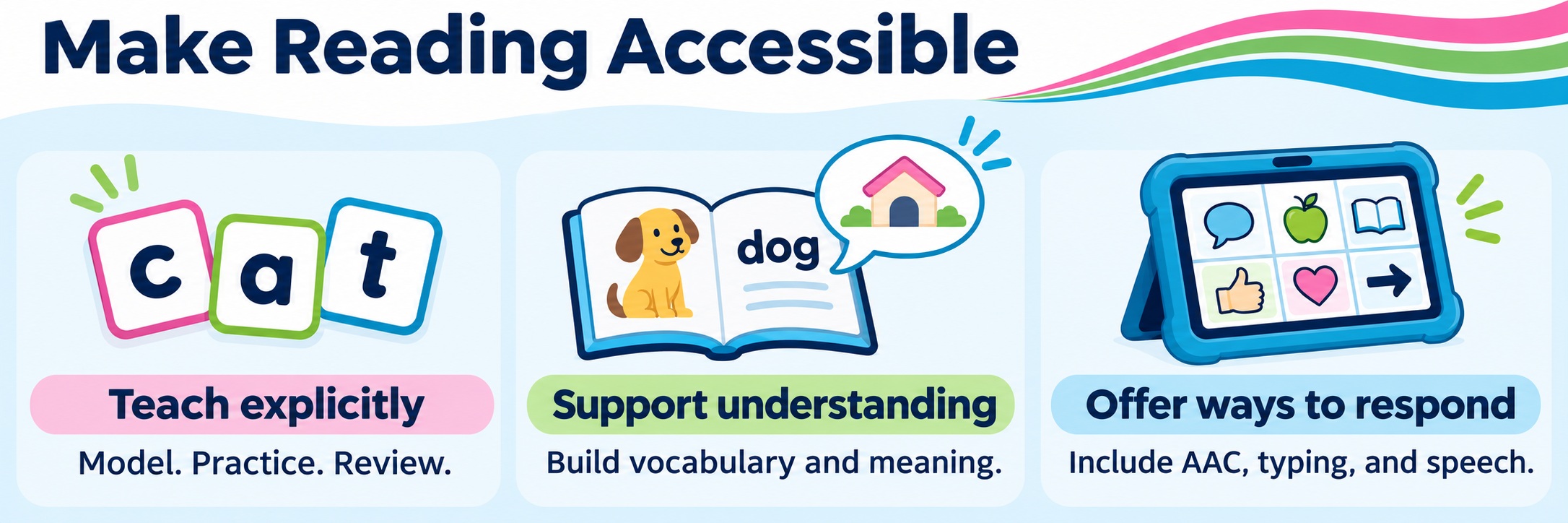
Use a planned sequence, clear modeling, guided practice, and review. Teach students how sounds connect to letters and how those relationships support reading and spelling.
For example, a lesson might introduce a sound–letter relationship, model blending, and provide practice with words containing previously taught patterns. Letter tiles or an accessible keyboard can give students another way to build words.
Choose practice words based on the instructional sequence. A seasonal word is useful only when it fits the skill being taught.
Build Vocabulary Through Meaningful Examples
Introduce a small set of useful words before reading. Explain each word in familiar language, show examples, and return to it during discussion.
For a November text about community helpers, teach words such as deliver, collect, or help. Students can explore the meanings through photographs, objects, demonstrations, and sentences.
Use pictures to support meaning while keeping attention on the printed words during decoding instruction.
Support Fluency Without Making Speech the Only Measure
For students who read aloud, supported rereading can provide practice with accuracy and phrasing.
For students who use AAC, plan accessible ways to practice and demonstrate reading. ASHA identifies literacy adaptations such as direct instruction in decoding and spelling, access to letter boards or adaptive keyboards, and shared reading with communication supports available.
Match the response method to the skill being assessed. Producing a spoken answer should not become an unnecessary barrier to showing understanding.
Teach Comprehension Alongside Word Reading
Plan discussion before, during, and after reading. Model how to identify a character, follow events, explain a problem, and connect ideas.
A student might demonstrate understanding by:
- Selecting a character using AAC.
- Arranging events in order.
- Choosing evidence from the text.
- Writing or constructing a sentence.
- Explaining an answer verbally.
Reading words and understanding a text are related skills that may need different supports.
2. Make ELA Instruction Accessible
Accommodations should address individual needs and align with the student’s IEP. They should also help students work toward the intended lesson goal.
Adjust the Environment and Pacing
Consider seating, lighting, noise, material placement, and access to breaks. Give students time to process directions and prepare responses.
A predictable routine can make the lesson easier to follow:
Review → Teacher model → Guided practice → Independent response → Feedback
Introduce visual schedules when they help the student understand what happens next.
Keep Communication Supports Available
Include AAC, picture supports, writing tools, and other communication methods throughout the lesson.
Plan opportunities for students to ask questions, comment, disagree, and request clarification—not only answer adult questions. Coordinate with the student’s speech-language pathologist and other team members when adapting communication access.
ASHA’s classroom guidance also emphasizes allowing time for students to navigate their devices and create messages.
Break Tasks Into Clear Stages
A direction such as “Read the story and write about it” may contain several separate demands.
A more accessible sequence could be:
- Read or access the assigned text.
- Identify the main character.
- Select an important event.
- Plan a sentence.
- Write, type, or construct the response.
- Review the finished work.
Provide feedback that tells students what they did successfully and what to try next. Adjust prompts as students become more independent.
3. Try a November Literacy Lesson With Multiple Ways to Participate
Seasonal themes can make instruction relevant without changing its core purpose. Choose topics that reflect students’ interests, family experiences, and classroom communities.
Example theme: Helping Our Community
- Vocabulary: Teach help, carry, and share using examples and demonstrations.
- Word reading: Practice words that match each student’s current phonics instruction.
- Shared reading: Read an age-appropriate story or informational text about helping others.
- Comprehension: Ask who helped, what happened, and how students know.
- Writing: Invite students to describe a helpful action using speech, AAC, handwriting, typing, or another accessible method.
- Peer participation: Give partners clear roles, such as choosing a question and sharing a response.
Keep the objective visible. If the goal is decoding, record decoding performance. If the goal is comprehension, use a response method that lets the student demonstrate understanding.
4. Use Student Responses to Guide the Next Lesson
Track more than whether an activity was completed. Note accuracy, independence, prompt levels, and the conditions under which the student responded successfully.
Ask:
- Which skills are becoming more independent?
- Where is the student making repeated errors?
- Does the response format accurately capture the target skill?
- Are sensory, motor, or communication demands limiting participation?
Share useful observations with families and the instructional team. Use them to adjust teaching, rather than assuming one approach will work equally well for every learner.
Build Literacy Access Into Every Lesson
Differentiated ELA instruction combines clear teaching with meaningful access. Students need opportunities to develop reading and writing skills, communicate their ideas, and participate in discussions with their peers.
This November, start with one lesson. Identify its purpose, check how each student can participate, and use their responses to plan what comes next.
Looking for support in your school? Explore Applied ABC’s school-based services to learn how our team collaborates with educators.